$1.7B, $300M, $152M: Three Theories of How Humanoid Robots Win
One week of funding, and what it says about the US, China and Europe
Between July 15 and July 22, 2026, three companies raised money to put humanoid robots to work. They were funded on three completely different premises.
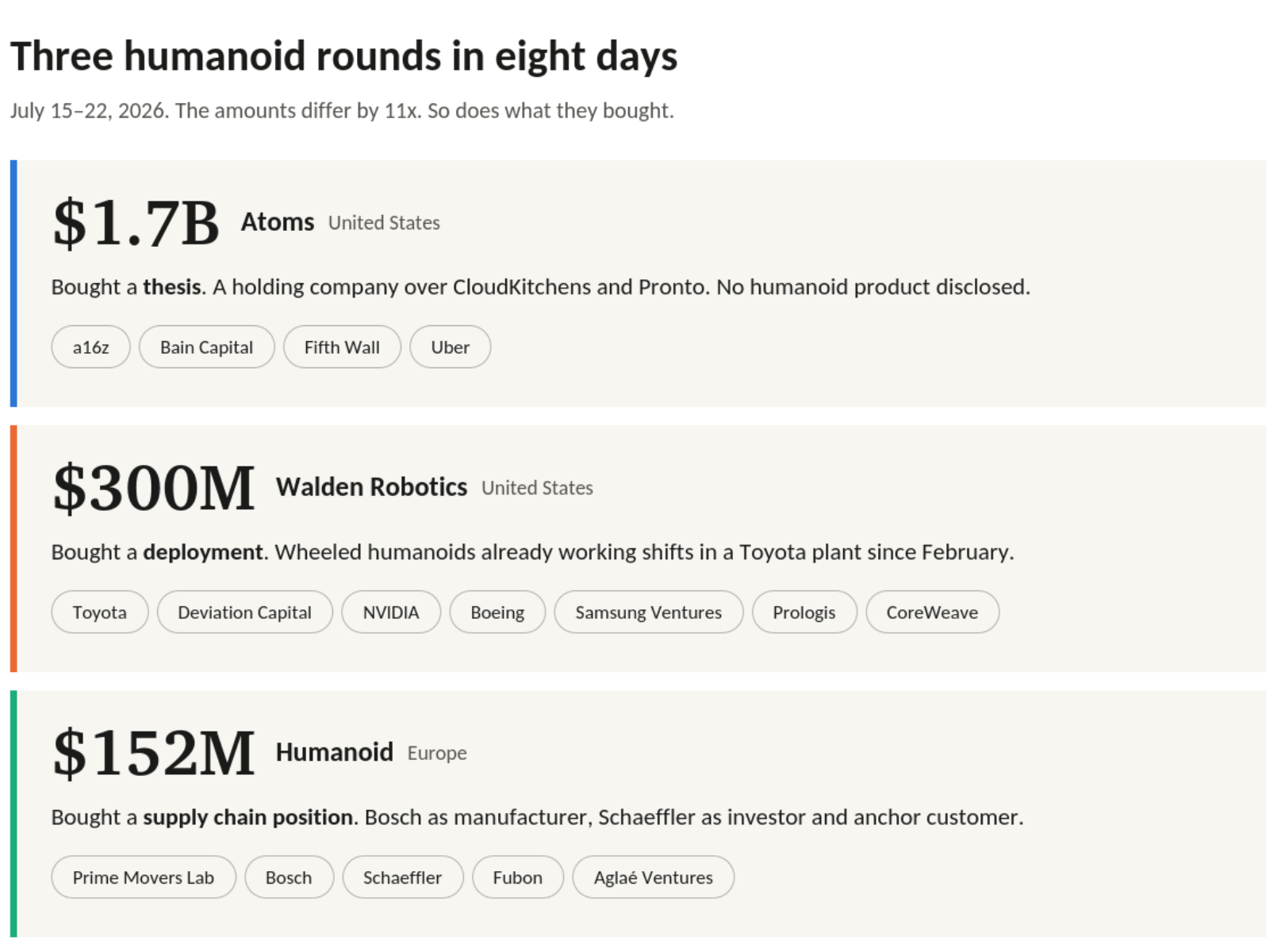
Atoms, Travis Kalanick's holding company, raised $1.7 billion led by Andreessen Horowitz, with Bain Capital, Fifth Wall and Uber.
Walden Robotics launched out of stealth with $300 million at a $1.1 billion valuation, co-led by Toyota and Deviation Capital, with NVIDIA, Boeing, Samsung Ventures, Prologis Ventures and CoreWeave Ventures participating.
Humanoid raised a $152 million Series A at a $1.35 billion post-money valuation, led by Prime Movers Lab, with Bosch, Schaeffler, Fubon Financial Venture Capital and Aglaé Ventures, becoming what it calls Europe's first pure-play humanoid robotics unicorn.
That's $2.15 billion in eight days. The amounts made the headlines. What each round actually bought is the more useful information. Lined up together, these three deals map the structure of the global humanoid industry.
The conventional wisdom: a regional mnemonic
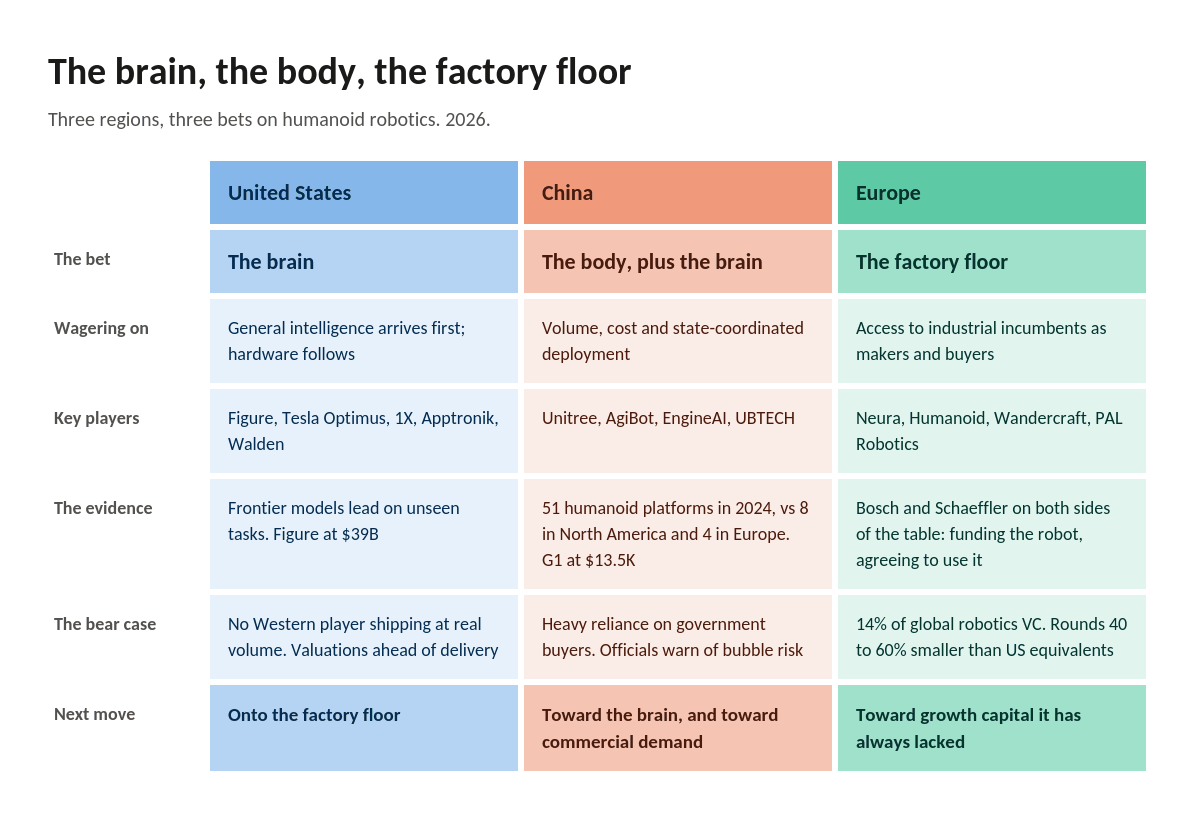
The industry shorthand: The US builds the brain. China builds the body. Europe builds the factory floor. It is a mnemonic, not a law. But it is a reasonable place to start.
Regional theses: how the US, China and Europe are betting
United States: the model layer and the deepest capital
American labs still lead on frontier generalist models: systems that hold up on tasks they have never seen before. Physical Intelligence, Google's Gemini Robotics and Skild AI sit at the front of that field. Open-source vision-language-action models have caught up on simulation benchmarks, but a visible gap remains on real-world zero-shot generalization.
The hardware field is crowded and richly capitalised. Figure, valued around $39 billion, has run enterprise pilots with BMW. Apptronik, around $5.5 billion, has worked with Mercedes. 1X, around $10 billion, is backed by OpenAI and Samsung. Tesla's Optimus programme is the structural outlier: vertically integrated, aimed first at Tesla's own factories, and therefore hard to benchmark against companies that must win external customers.
Those valuations are the clearest statement of the American thesis. The bet is that general-purpose intelligence arrives first, and that whoever owns it can pick their hardware later.
The bear case: none of the leading Western players is shipping at real volume. Mass production remains the unproven step, and valuations have moved well ahead of delivery.
Atoms: the capital narrative
Atoms is the outlier. It is not a humanoid company in any conventional sense; it is a rebranded holding company currently housing CloudKitchens and Pronto, a heavy-industry automation firm. While Travis Kalanick has alluded to building a "wheelbase for robots," the current strategy leans heavily toward logistics and facilities automation.
Atoms belongs in this comparison purely for the arithmetic: it raised 11 times the capital of Humanoid in the same week, fueled by a founder's record rather than a signed industrial contract. This highlights a fundamental structural divergence. American risk capital will fund a robotics narrative at a scale that European capital will not fund a robotics contract. Whether this distribution leads to breakthrough innovation or massive write-offs remains an open question, but it dictates precisely why company formation and scaling follow such divergent paths between the two continents.
It is also a reminder that a meaningful share of the money reported as flowing into this sector is not going into humanoids at all.
China: no longer just the body
The reflexive framing of China as merely a low-cost hardware producer is outdated. On volume, the lead is clear: Chinese firms unveiled 51 humanoid platforms in 2024, far outpacing Western counterparts. Unitree and AgiBot are already shipping units in the thousands, transitioning quickly from research to application-ready hardware.
On volume, the lead is real. Chinese firms unveiled 51 humanoid platforms in 2024, against 8 in North America and 4 in Europe. Unitree's G1 sells for around $13,500, a fraction of Western equivalents, and shipped over 5,500 units in 2025. AgiBot currently leads global humanoid shipments. EngineAI has built production capacity in Shenzhen aimed at annual output in the thousands, positioning its PM01 and T800 as application-ready systems rather than research platforms.
The state’s role functions as a massive force multiplier. Beijing’s 'Five-Year Plan' priorities and competitive municipal subsidies, spanning compute vouchers, direct R&D grants, and massive data collection infrastructure, create a fiscal and physical runway that few Western startups can replicate.
The bear case: Heavy reliance on state-owned procurement and 'To-G' models creates market distortion. As founders navigate the 'year of elimination,' the industry is now pivoting to address the risks of over-saturation and the necessity of finding true commercial demand beyond government contracts.
Europe: industrial integration
Europe's position is the narrowest of the three, and on the obvious metrics it looks weak. Europe unveiled 4 humanoid platforms in 2024. It has no humanoid company shipping at the volume of Unitree, Figure or Agility. It captured only about 14% of global robotics venture capital in 2025. On foundation models it is the thinnest of the three, leaning on partners such as NVIDIA rather than shipping its own.
What Europe has instead is visible in this month's cap table rather than in any leaderboard: access to industrial incumbents as manufacturers and as customers.
Bosch is Humanoid's contract manufacturer. Schaeffler is, according to the company, both an investor and an anchor customer for a large-scale factory deployment. A month earlier, Neura Robotics raised a Series C of up to $1.4 billion at roughly $7 billion, with a syndicate spanning NVIDIA, Qualcomm, Amazon, Tether, Bosch, Schaeffler and the European Investment Bank. In both cases, the same German industrial names appear on both sides of the table, funding the robot and agreeing to use it.
That access is the European product. A humanoid startup elsewhere must find a factory willing to take the risk; a European one is being handed the factory, the manufacturing line and the safety-certification experience at the same time.
There is a second, less obvious asset. The EU AI Act imposes conformity assessments and human-oversight requirements on high-risk autonomous systems. That is friction, but several European analysts read it as a moat favouring incumbents with decades of CE-certification experience. American and Chinese entrants face a regulatory onboarding curve that European firms navigate natively.
The bear case: Series B and C rounds in Europe run 40 to 60% smaller than US equivalents, and the continent invests up to 3x less per capita in late-stage venture. Drumbeat Capital's 2026 deep-tech report estimates that roughly 89% of European deep-tech exit value leaves the continent, mostly to US acquirers. (The report is written by an investor with an interest in the argument, and worth reading with that in mind.) European factories also pay two to three times the electricity costs of US or Chinese peers.
The same report notes a talent paradox. Europe has roughly 30% more AI talent per capita than the US and produces about twice as many STEM graduates, yet runs a net outflow of senior AI professionals to the US and UK. Analysts generally describe this less as a talent shortage than a scale-up problem: Europe creates companies and people, then struggles to keep them through the capital-intensive growth phase.
The institutional brake
A common theory is that European social attitudes slow adoption, but the data complicates this. Eurobarometer polling finds 62% of Europeans view robots and AI positively in the workplace. Majorities do worry about job losses, but the caution Europeans express is about governance rather than adoption, and research from the Centre for the Governance of AI finds American publics hold that view just as strongly. That makes public perception a poor candidate for a distinctly European brake.
The real drag is institutional friction: AI Act conformity procedures, works-council negotiation cycles, and complex safety-certification paths. For a humanoid company, this results in a slower clock on every deployment, a compounding cost that puts European entrants at a disadvantage against the rapid-fire timelines favored by American and Chinese competitors. It is not a public that rejects the technology; it is a regulatory environment that forces it to move at an administrative pace.
Where each region pushes next
Two of the three regions are moving directly into each other's squares. The third is doing something different in kind.
The US is moving onto the factory floor. Walden spun out of Toyota Research Institute in January 2026. By February its robots were doing production work at a Toyota plant in North America, first pilot to real work in under two months, with one machine reported to be running eight-hour shifts alongside human teams on tasks like loading car parts, cleaning machinery and kitting for assembly. The technology base is Diffusion Policy, Large Behavior Models, the Universal Manipulation Interface and the Drake simulator. The CEO is Russ Tedrake, an MIT professor and former SVP of Large Behavior Models at TRI.
The detail that matters most is the form factor. Walden's robot is a humanoid torso with two arms on a wheeled base, and Tedrake's stated reason is that wheels are easier to certify under existing factory safety rules, since rolling machines already have standards that walking machines do not. He told Bloomberg that factory-floor workers "aren't ready" for legged robots.
That is the same bet Humanoid has made in Europe with its wheeled HMND 01. Two companies, two continents, arriving independently at the same compromise for the same regulatory reason. It is the strongest evidence in this month's news that the industry's near-term constraint is certification, not locomotion.
China is moving toward the brain, and toward commercial demand. Open-source VLA and world models address the first. The industry's own debate about moving past government buyers addresses the second.
Europe's move is not into another square. It is toward the resource Europe has always lacked. Neura's investor list is what importing growth capital looks like in practice: American compute, American logistics, crypto, German industry, and the European Investment Bank in a single syndicate. That is a different kind of manoeuvre from the other two, and arguably a more revealing one.
What to watch over the next twelve months
Three signposts should settle much of the above, one per region.
1. Does Humanoid convert contracts into installations? Its Beta robots are slated for customer sites in Q4 2026. Europe's entire thesis, that industrial relationships beat capital depth, rests on deployments that have not happened yet.
2. Does Walden win a second customer outside Toyota? Toyota is Walden's spin-out parent, investor and first factory. A deployment at Boeing or another unaffiliated manufacturer would show the model generalises; continued dependence on Toyota would suggest what looks like commercial traction is really internal adoption.
3. How much of China's 10,000-unit target is commercial? The national programme will likely be met. The question is the split between government procurement and paying industrial customers. If the "To-G" share stays dominant, China's deployment lead means less for model training and unit economics than the headline number suggests.
The end of regional silos
Ultimately, asking "who is ahead" misses the point. We are entering a paradox of entanglement. While we categorize these companies by region, their technology stacks and cap tables are increasingly globalized:
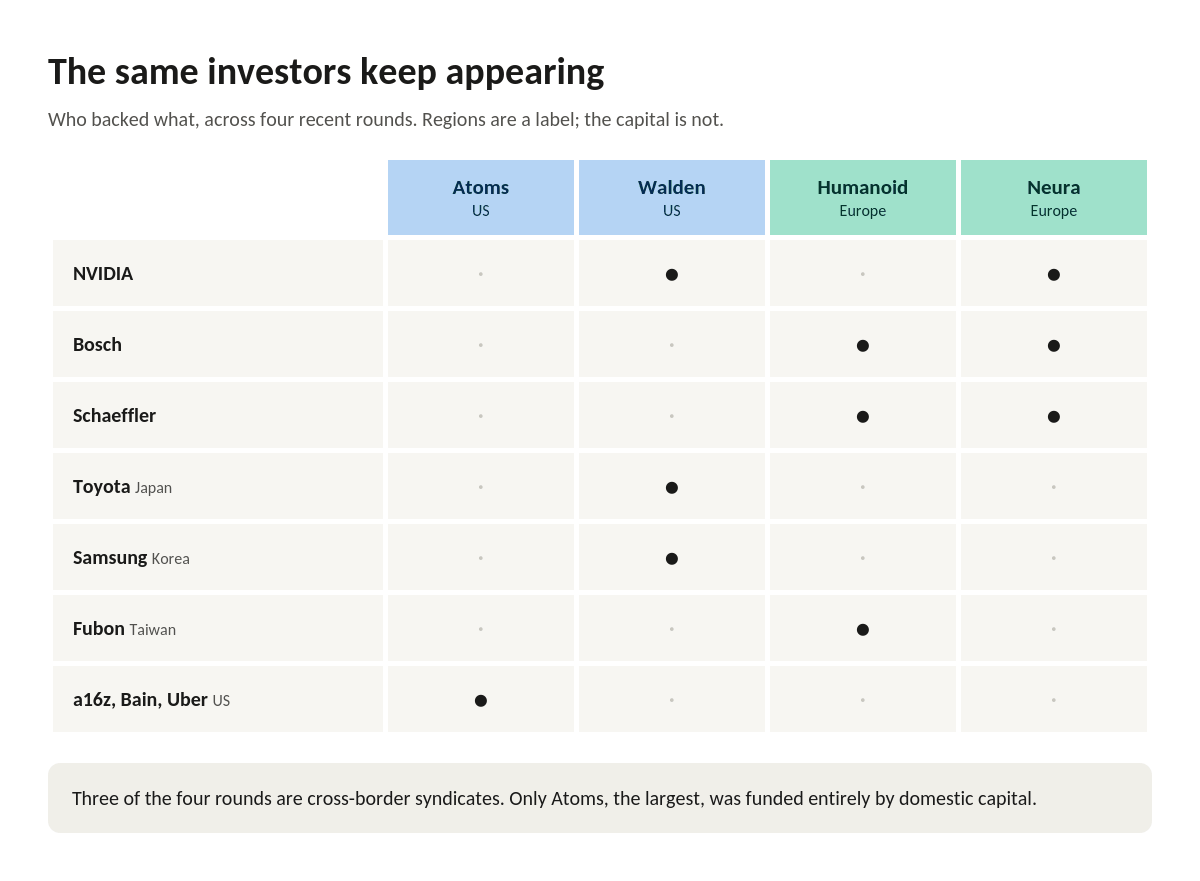
- NVIDIA is an investor in both Neura (Europe) and Walden (US).
- Bosch and Schaeffler appear in both Humanoid and Neura.
- Toyota (Japan) co-led Walden; Samsung and Fubon (Taiwan) participated in cross-border rounds.
- Of this month's rounds, only Atoms was funded entirely by domestic capital.
The real competition is not US versus China versus Europe. It is between companies capable of bridging the gap between certification, innovation, and actual, volume-based commercial delivery. In the next 18 months, regional advantage will matter far less than the ability to scale amidst this highly integrated global ecosystem. The winner will not be the region that builds the best model, but the company that best manages the entanglement of global capital, local certification, and industrial-scale manufacturing.
Sources
- Funding rounds: Business Wire and The Robot Report (Walden Robotics); Humanoid and Prime Movers Lab; TechCrunch (Atoms); Bloomberg, The Next Web and DC Velocity (Walden form factor and deployment).
- China policy and industry: MERICS, Embodied AI: China's ambitious path to transform its robotics industry; Jamestown Foundation (municipal policy instruments, Unitree prospectus disclosures); CMRA; MIIT and SASAC programme announcements; Shanghai Stock Exchange filings.
- Europe: Drumbeat Capital 2026 Deep Tech Report (exit value, talent); Dealroom (robotics venture funding); McKinsey; European Investment Bank.
- Public attitudes: Eurobarometer surveys on European attitudes to digitalisation, robots and AI at work; Centre for the Governance of AI.