Why Is It the Unitree G1 That Keeps Showing Up in Robot Fights?
Across the public humanoid fights that can be verified today, one machine recurs with striking regularity: the Unitree G1. It is tempting to read that recurrence as a verdict on fighting ability. That reading is almost certainly wrong.
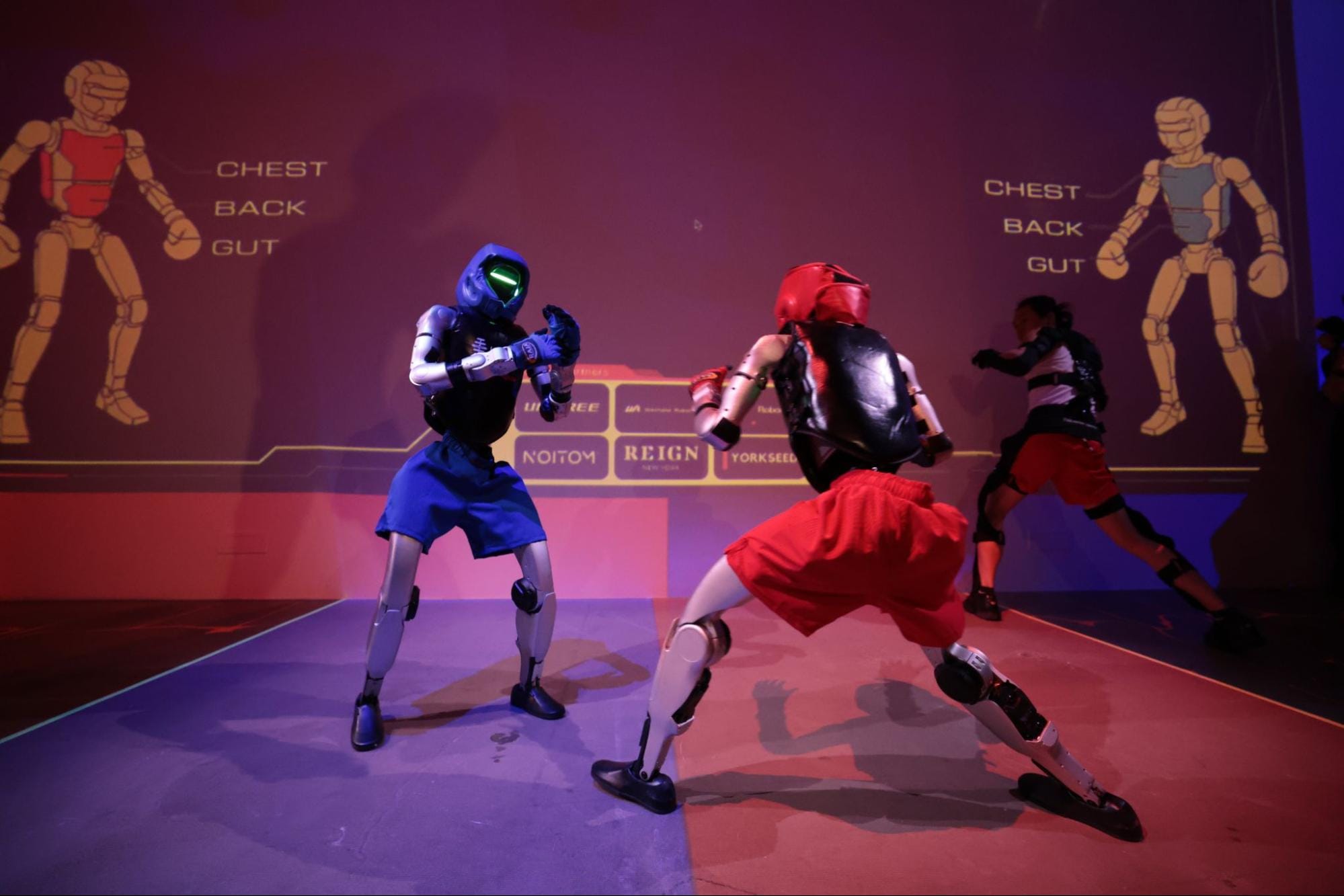
Public robot combat does not select for the best humanoid in the abstract. It selects for a different and more mundane set of properties: whether teams can actually acquire the robot, control it, modify it, transport it, repair it, and return it to the ring for the next event.
Viewed through that lens, the G1's dominance is less a statement about its punch than about the ecosystem that has assembled around it.
A fight is an operations problem, not a locomotion benchmark
The audience sees strikes, footwork, and recovery. The organizer sees a considerably longer checklist. Before the first round begins, someone must source multiple robots on a real schedule, stand up a control system, train operators, move and stage the hardware, absorb failures, and have everything ready again by the next match.
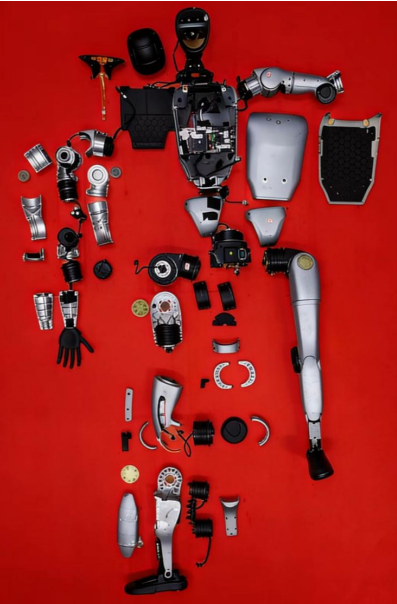
That reframing changes what "good robot" means. A humanoid can possess exceptional locomotion and still be a poor competition platform — if only a handful of institutions can obtain it, or if every event requires the manufacturer's direct involvement. The operative question is therefore not whether a humanoid can fight, but whether a third party can run it.
The first gate is access
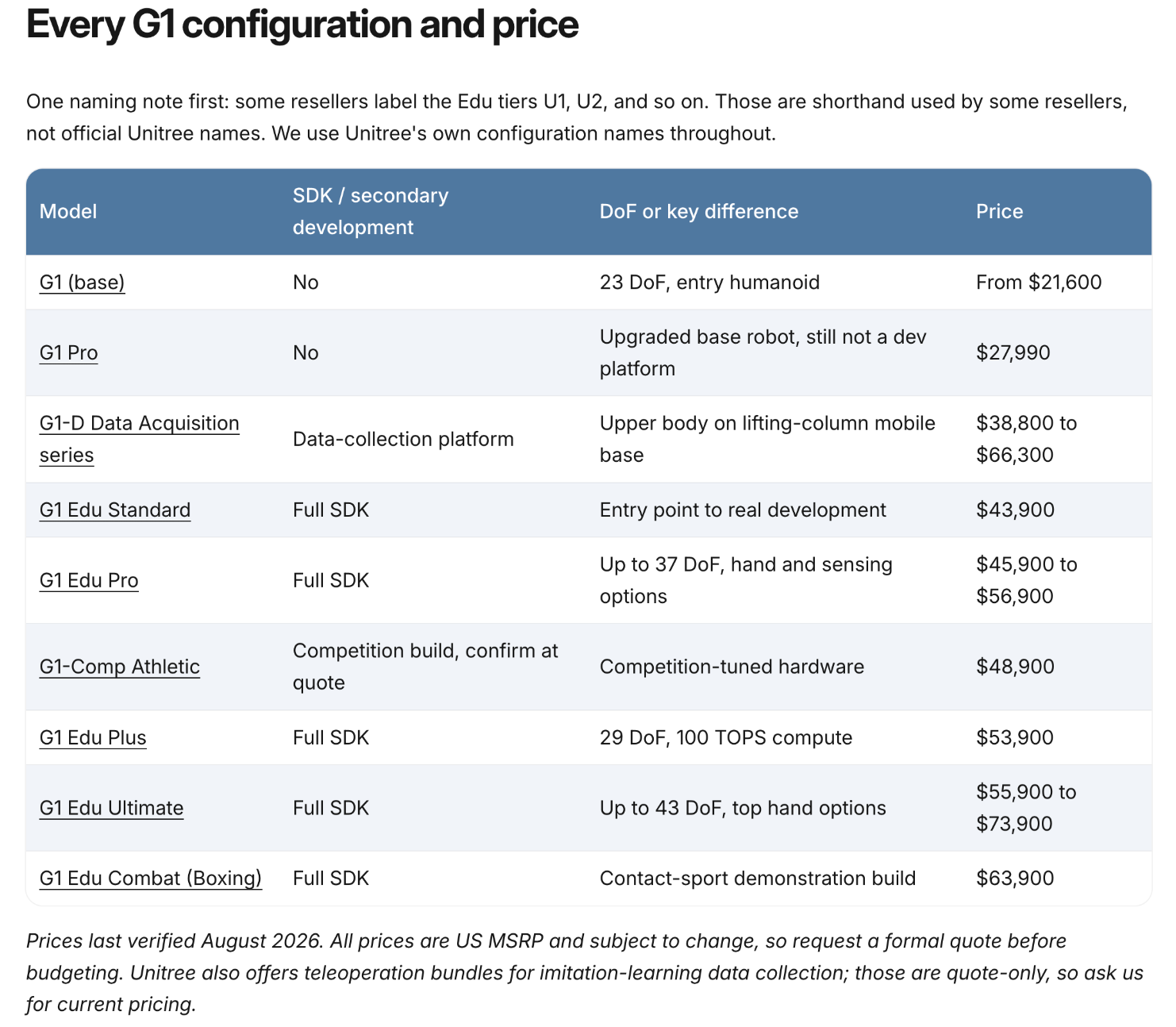
Unitree lists the base G1 from roughly $13,500 on its own store, a figure frequently cited as evidence of affordability. On closer inspection the number is more nuanced than it appears. The base configuration ships without SDK access and does not support secondary development; by multiple dealer and product-page accounts it is effectively a demonstration and education unit. The developer-grade path — the version an organizer would actually build a fight around — is the G1 EDU line, quoted from approximately $43,900 and rising past $70,000 across configurations, with a competition-oriented build listed near $35,000 through RoboCup's program. Freight, batteries, protective hardware, spares, and engineering labour sit on top of all of these.
The meaningful advantage, then, is not that the G1 is cheap. It is that the G1 offers a legible acquisition path: a published product, defined configurations, transparent pricing tiers, and identifiable support channels. That legibility is precisely what distinguishes it from a vendor whose entire annual output is committed to selected enterprise partners. The robot's physical format reinforces the point — at roughly 1.32 metres and 35 kilograms with a folding body, several units can be transported and staged with far less overhead than a full-scale industrial humanoid. For an organizer trying to place multiple machines in a single venue, sophistication matters less than sufficiency: the goal is enough capable robots to run the event at all.
Software is where the robot becomes a platform
The second gate is developer surface, and here the G1 begins to behave less like a product and more like a platform. Unitree publishes SDKs, ROS and ROS 2 interfaces, simulation and reinforcement-learning tooling, and XR-based teleoperation support. Its public repositories attract thousands of stars and hundreds of forks, an indicator of developer attention rather than a census of active combat builders, but a meaningful signal nonetheless.
The distinction is consequential. A closed platform can be technically excellent and still impose a tax on experimentation: if every new behaviour requires the manufacturer, iteration slows and costs rise. An open surface lets teams build their own control systems, simulation workflows, and teleoperation stacks. REK is the clearest illustration — its events run on custom VR-based control built around the G1, rather than treating the robot as a turnkey appliance. The value is not that the hard problems are already solved; it is that no team has to begin from zero.
What accumulates next is harder to copy than hardware
Over successive events, something forms that never appears on a specification sheet: operational experience. Unitree reported delivering more than 5,500 humanoid units in 2025, a figure spanning its full humanoid business rather than the G1 alone, and associated by industry analysts (Omdia) with roughly a third of global humanoid shipments. Scale of that order has downstream effects. Each public appearance in China, the United States, Japan, and elsewhere produces operators fluent in the hardware, engineers who understand its failure modes, teams with control systems already written, and organizers who know what staging the platform actually requires.
None of that capital disappears when a competitor ships a robot with better motors.
The result is a plausible flywheel:
more robots → more trained operators → more tooling → more accumulated experience → lower integration friction → more
events
This is an inferred mechanism, not a measured one. No organizer has published procurement scorecards or platform-switching costs, and the claim should be held at that confidence level. But the event history is consistent with it. The first event of this kind is hard; the second is easier; the tenth can look almost routine.
Western humanoids are optimized for a different game
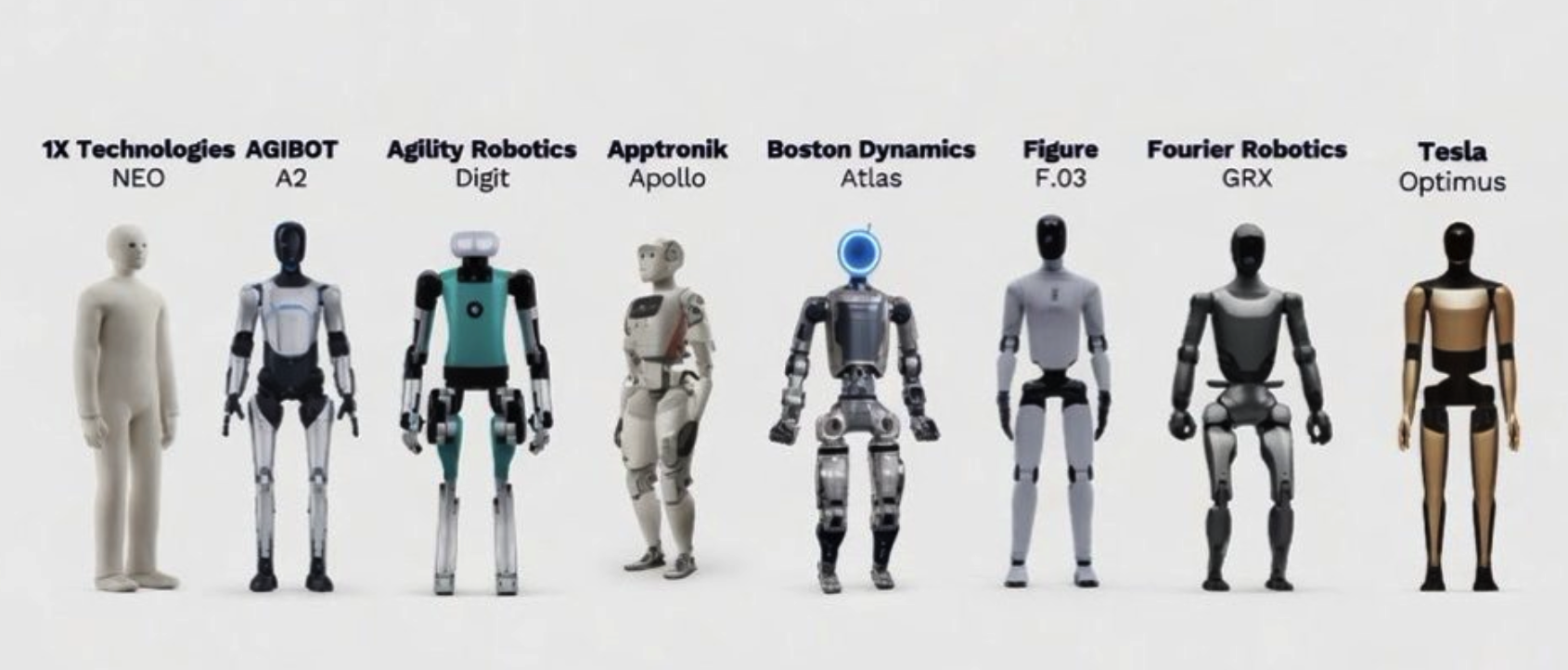
Several of the most capable humanoids in the world are largely absent from the public ring. Boston Dynamics' Atlas is moving toward industrial deployment with Hyundai and other partners; Figure concentrates its fleet on internal research and selected commercial programs; Apptronik's Apollo advances through enterprise applications; Agility's Digit is positioned as a managed industrial system.
Their absence is better explained by access model than by capability. A public fight asks a manufacturer to permit an unusual degree of third-party experimentation, handing over hardware to be modified, teleoperated beyond normal operating envelopes, damaged, repaired, and run again. That is a poor fit for a company selling humanoids into controlled industrial workflows. It would be a mistake to read the absence of Atlas or Figure as evidence of G1 superiority; more likely, these firms are simply playing a different game.
The ring evaluates the ecosystem, not only the machine
This is what makes the G1's position more interesting than any head-to-head spec comparison. A competitor can eventually match torque, speed, or degrees of freedom. It is far harder to reconstitute, on demand, the surrounding ecosystem: developers who already know the platform, operators with accumulated hours, mature simulation and control tooling, organizers familiar with the hardware, engineers practised in recovery, and upstream of all of it, a manufacturer willing to keep the platform open in the first place. That is a fundamentally different moat from motor performance.
It also suggests why recurring public competition may become a useful lens on humanoid platforms more broadly. A polished demonstration reveals what a robot can do under prepared conditions. A competition that returns month after month reveals something else entirely: how much infrastructure genuinely exists around the machine.
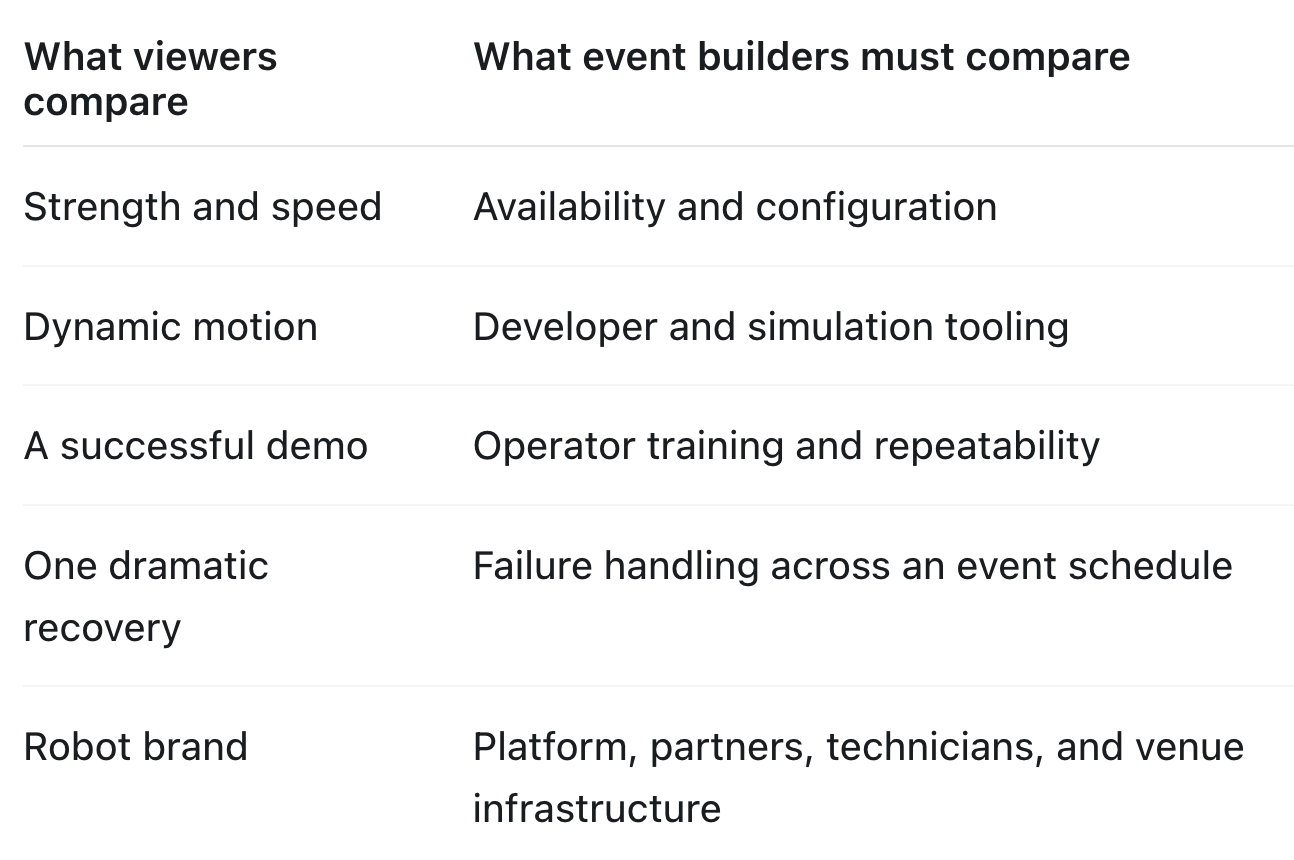
When viewers compare humanoids, attention naturally falls on the visible questions — how hard it strikes, how fast it moves, how well it recovers. Those matter. But for anyone actually staging a competition, the unglamorous questions matter at least as much: Can the hardware be obtained? Can a third party control it? Can the software be adapted? Can engineers repair it? Can the same platform return next month?
That is why the most consequential development in robot fighting is not the fighting. It is the emergence of a platform ecosystem around a small number of machines. For now, the Unitree G1 holds a meaningful head start, not necessarily because it is the strongest humanoid, nor because it produces the most impressive demonstration, but because more of the pieces required to make a fight happen are already in place.
The hard part is never getting a single robot to throw a punch.
The hard part is building a platform that can keep showing up.