Why Most People Evaluate Robot Fighters the Wrong Way
The best fighting robot isn't the one that punches hardest. It's the one that recovers fastest.
Watch enough humanoid robot demos and you'll notice a pattern: almost all of them end within two minutes.
It isn't that the robot runs out of moves. It's that lasting is the hard part. As the runtime stretches, the difficult variables pile up — batteries drain, motors and power electronics heat up, state estimates drift, and the small margin of control that made the first clean take possible gets eaten away. A polished clip is usually the one successful shot pulled from many attempts. That's normal demonstration practice. It is not an operational benchmark.
The length of a robot demo is itself a performance metric.
Which is why judging a fighting robot by a single punch or a torque figure, or a martial-arts routine, gets it backwards.
A fighting robot is not defined by how hard it swings an arm. It's defined by whether it stays useful after the world pushes back. Fighting capability comes down to two tests: can the robot control its whole body through contact, and can it keep doing that, round after round?
Most humanoid demos answer part of the first. Almost none answer the second.
Key Insight:
A robot that throws one convincing punch is a demo.
A robot that can recover, cool, recalibrate, and return for the next round is a platform.
A fighting robot is a stack, not a spec sheet.
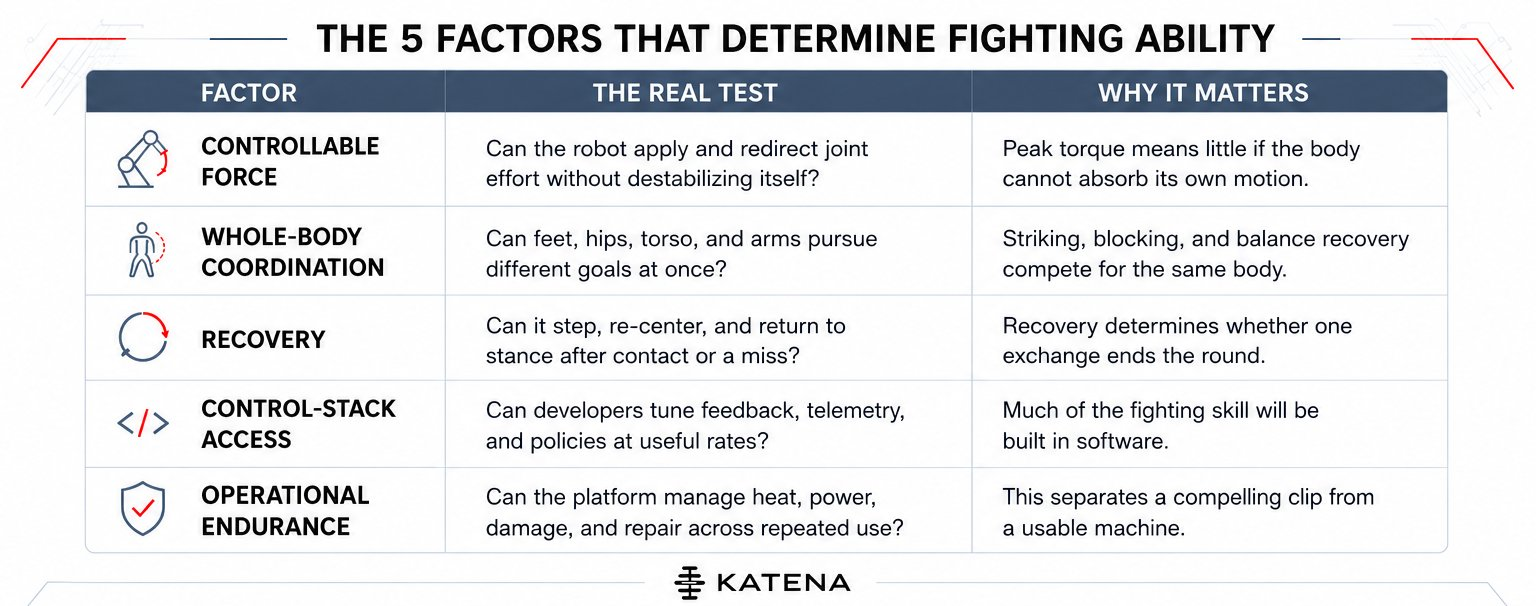
The first four factors decide whether a robot can start fighting. The fifth decides whether it can keep fighting. The first group produces the exciting video. The second produces the useful product. Here's each half in turn.
Can it start: why control beats strength
A punch is the least revealing moment in a fight.
It moves the arm, yes—but it also shifts foot loading, rotates the torso, moves the center of mass, and creates a recovery problem the instant it lands, misses, or is blocked.
That's why "which humanoid is strongest?" is the wrong question. Strength without control just makes the instability more violent. Fast arms without reactive stepping turn a missed punch into a fall. The better question is this: can the machine turn force into controlled, repeatable behavior under disturbance?
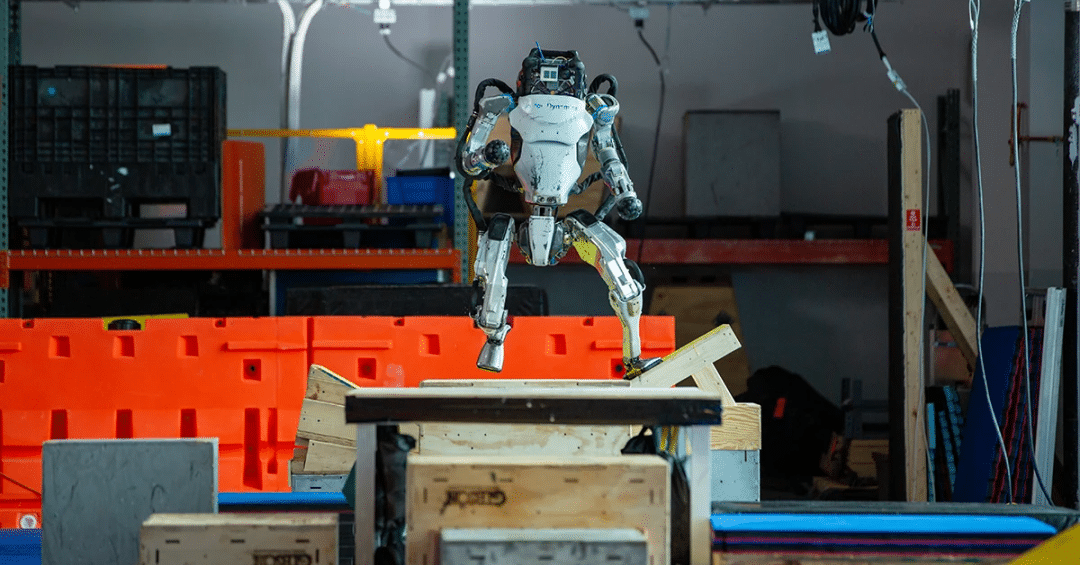
Dynamic humanoid movement depends on predicting and correcting the motion of the entire body, not merely commanding individual limbs.
Boston Dynamics' Atlas offers the clearest public lesson. Its parkour work runs on model-predictive control: sensing the robot's state, predicting where the body is heading, and correcting before an error becomes unrecoverable. Atlas isn't a commercial fighting robot—but that's not the point. The point is that dynamic humanoid behavior isn't a library of motions. It's a continual negotiation with physics.
Dynamic humanoid behavior is not a library of motions. It is continual negotiation with physics.
This is why whole-body control isn't an academic luxury. Fighting isn't arm motion; it's coordination across feet, legs, torso, and arms at once. A punch shifts the center of mass. A step changes the support region—the patch of stable ground your feet enclose. A block might demand that the upper body rotate while the lower body holds steady. Whole-body control lets a robot keep balance, plant a foot, hold a guard, and cap joint forces simultaneously. Without it, a humanoid performs a scripted motion. With it, the machine has a chance when the script breaks.
And recovery is where the real difficulty lives. The punch isn't hard; the recovery is. A robot has to handle lateral shoves, awkward contact, partial slips, and forces it didn't predict exactly. Small errors can be corrected at the ankle. Larger ones need the hips and torso to manage angular momentum. Serious disturbances demand reactive stepping.
The first punch matters less than the robot's response to the second.
Foot design belongs in this argument too. Traction, contact area, sole compliance, and stance geometry decide which recovery strategies are even physically possible—software can't recover a stance the mechanics rule out. The same logic applies to latency. The test isn't a universal millisecond threshold; it's whether sensing, state estimation, computation, communication, and actuator response can produce a useful correction before the robot loses the exchange.
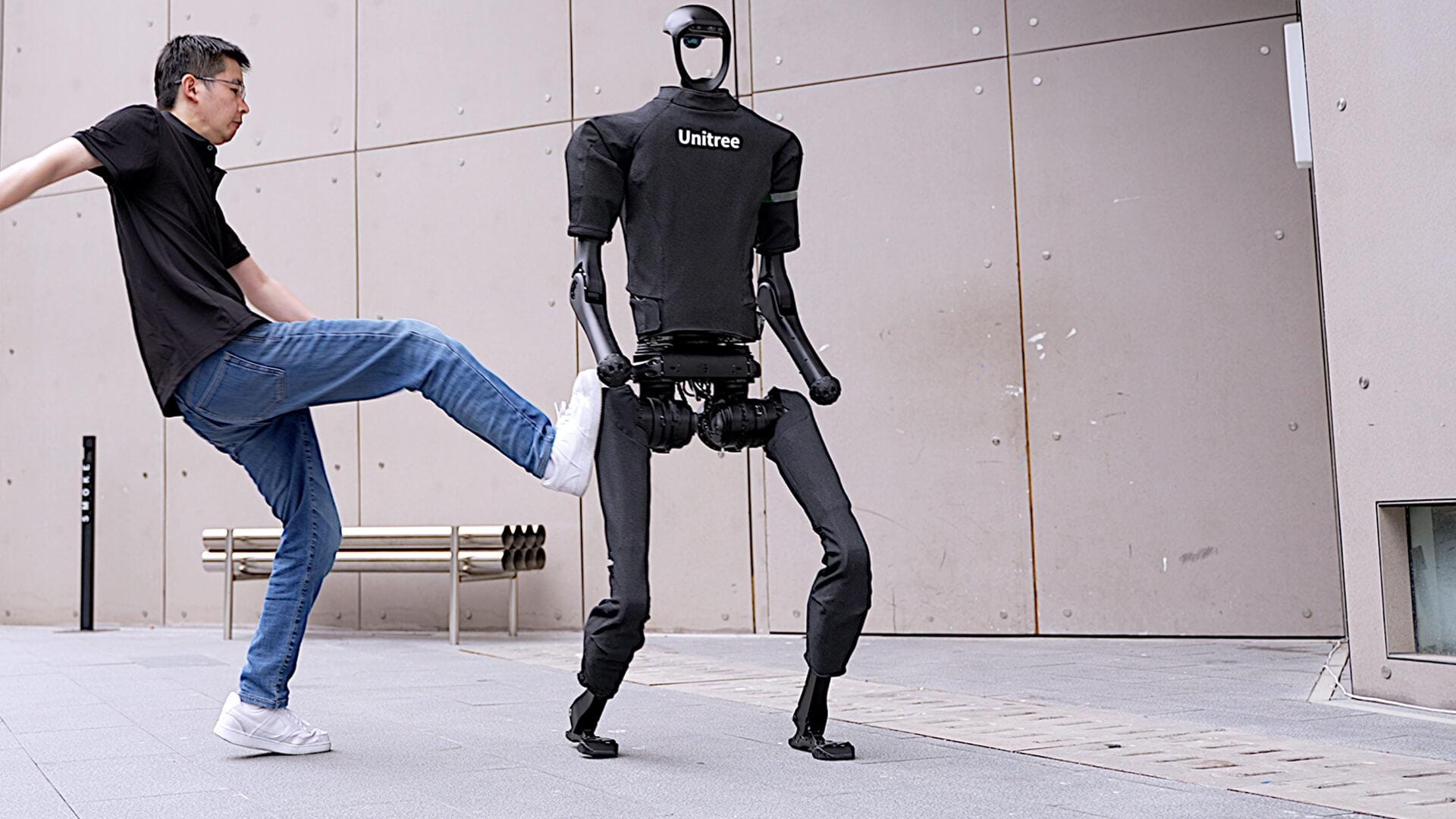
Unitree's H1 is a good example of how to read public evidence. Its in-place backflip shows high-energy force generation, body rotation, landing control, and a stable finish. That's no proof of combat readiness. But it is evidence that the platform has already confronted a more relevant problem than ordinary walking: coordinating the full body at speed.
Then there's the question of who can build all this. For a team developing fighting capability, the SDK is part of the hardware. Real-time control hooks, inertial and contact feedback, actuator interfaces, telemetry, and modifiable recovery behavior determine whether a team can move past scripted demos. Teleoperation matters for the same reason—it lets operators demonstrate guard changes, feints, reactive steps, and timing without hand-authoring every movement, shortening the path from human skill to usable training data. The robot still needs local autonomy when human intent and physical reality diverge, but teleoperation is the practical bridge.
Can it continue: why survival beats spectacle
Now back to that two-minute tell. This is the test the demos hide.
Short demos aren't useless, they're incomplete. Two questions are worth asking: what did the robot do? And: how long did it keep doing it?
The second is usually the more revealing one.
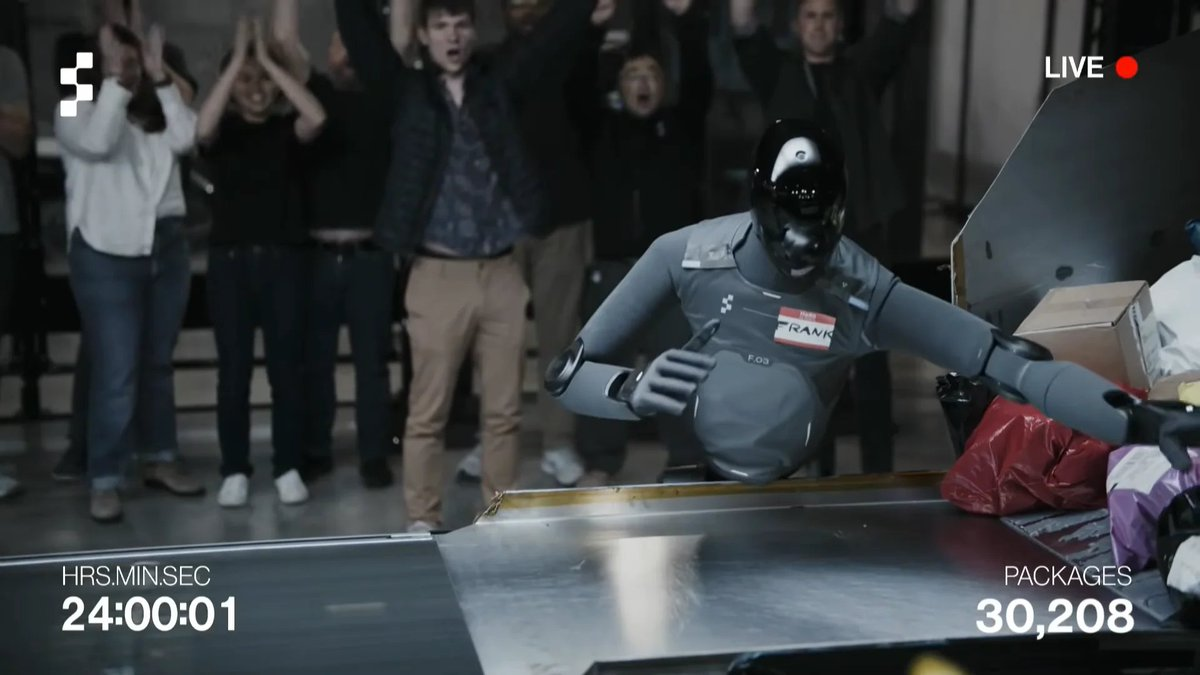
A dynamic humanoid platform is only the starting point; fight suitability depends on whether control performance survives once contact, heat, and wear accumulate.
BMW's Figure 02 deployment at its Spartanburg plant is valuable precisely because it answers the second. Running ten-hour shifts Monday through Friday, the robots logged roughly 1,250 operating hours, loaded more than 90,000 parts, and contributed to the production of over 30,000 BMW X3 vehicles across about ten months. That doesn't make Figure 02 a fighting robot. It establishes something more fundamental: operational maturity is measured in shifts, not clips.
For a combat platform, sustained output, stable state estimation, and recovery after degradation matter far more than a flawless ninety-second routine.
One detail drives the point home: Figure 02's leading failure point was the forearm, driven by tight packaging and the thermal constraints that came with it. What held it back wasn't strength. It was heat.
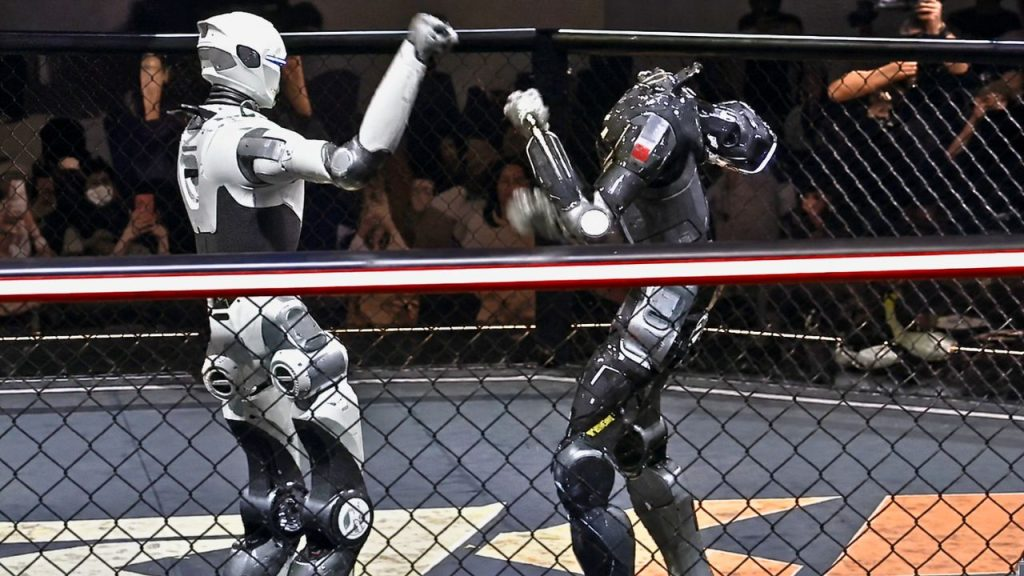
If BMW proves duration, EngineAI's T800 offers a more direct combat signal: graceful degradation. In July 2026, EngineAI staged URKL in Shenzhen, billed as the world's first freestyle humanoid fighting league, with 32 teams competing on a standardized T800 platform. In the opening bout, a roundhouse kick knocked the head clean off one T800, taking its head-mounted cameras and sensors with it. The robot kept throwing and absorbing punches on its torso-based core systems, finished the match, and won it 3–2 over five rounds.
The spectacle isn't the point. The public record doesn't establish which functions were lost, how the system degraded, or whether it stayed safe—all of that deserves skepticism. But continuing to operate after visible hardware failure is a more relevant combat signal than a flawless choreography clip. It points to fault tolerance, recoverable failure, and the ability to keep working while damaged—which is exactly what fight suitability demands, far more than perfect movement under ideal conditions.
It's worth noting that the T800 is fundamentally an industrial humanoid built for logistics, moonlighting as a cage fighter—which only reinforces the argument. What let it finish the match after losing its head wasn't some combat-specific trick. It was a solid operational chassis.
And that chassis is a single system: battery capacity, thermal management, durability, diagnostics, and repairability, all wired together. High-power motion makes heat. Repeated impacts stress joints, cables, connectors, sensors, and calibration.
The best demo isn't the one that looks strongest. It's the one that keeps working.
Applying the framework to today's humanoids
This isn't a ranking of the "best" humanoids. Different evidence answers different questions.
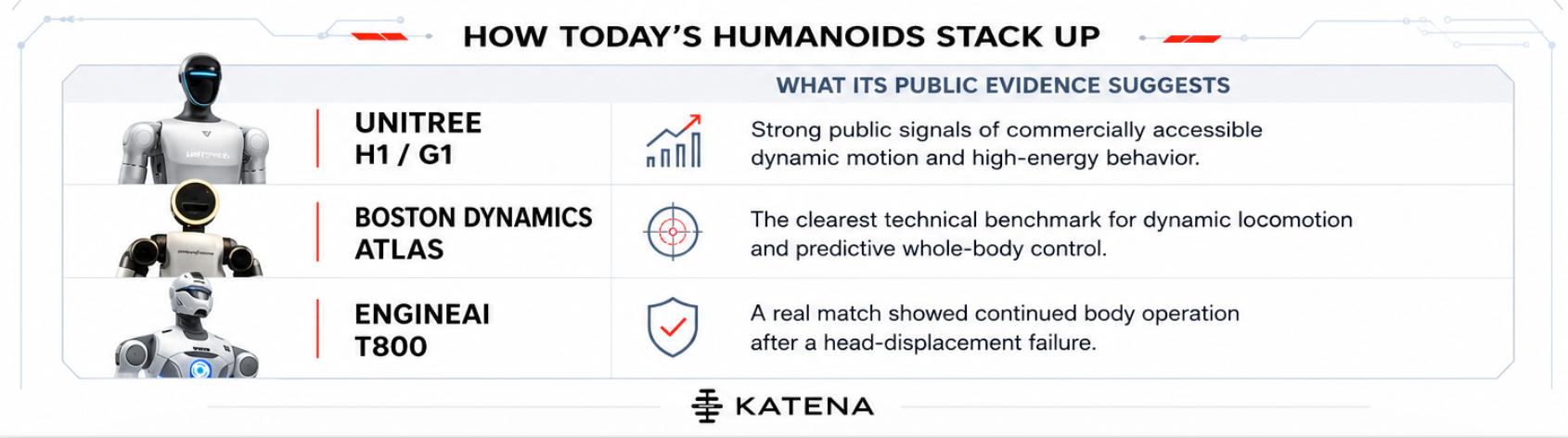
Atlas shows what elite dynamic control can look like. Unitree shows that commercially accessible robots are starting to demonstrate relevant movement. BMW's Figure 02 deployment shows why duration matters; the T800 incident shows why graceful degradation matters.
A backflip is not a bout. A production shift is not an impact test. A robot limping on after damage isn't one either—but each reveals a capability that a choreography clip can hide.
The winning robot-fighting platform will be the one whose control stack can recover from reality and whose hardware can survive the recovery.